
Elemental Analysis for Battery Materials: What Tests Do You Actually Need?
Why does elemental composition matter in battery technology?
A battery's performance is ultimately determined by its chemistry, and its chemistry comes down to elemental composition. Whether that means verifying the lithium-to-cobalt ratio in a cathode material or detecting trace iron contamination in an electrolyte, elemental accuracy is what separates a battery that performs as expected from one that doesn't.
For manufacturers, R&D departments, and quality teams, getting this right is essential. Elemental analysis testing sits at the centre of production decisions, batch release, failure analysis, and regulatory compliance.
What types of battery materials can be tested?
Elemental analysis can be applied across the full range of materials found in a battery cell, including:
Cathode materials — lithium nickel manganese cobalt oxide (NMC), lithium iron phosphate (LFP), and lithium cobalt oxide (LCO). These similar chemistries all depend on getting the active element ratios right. Lithium, cobalt, nickel, manganese, iron, phosphorus, and aluminium are the usual elements here.
Anode materials — graphite, silicon, and tin-based compounds are the most common. Carbon, hydrogen, and nitrogen content are the primary focus, but metallic impurities are worth screening for too, as they can degrade cycle performance over time.
Electrolyte salts and solvents — the presence of key elements such as lithium, phosphorus, and fluorine needs to be confirmed alongside screening for contaminant elements such as sodium, potassium, and chlorine.
Current collector foils — copper and aluminium foils are standard. Purity testing is a routine part of qualifying incoming material before it can be used in production.
Separator membranes and conductive additives — the right analytical approach depends on whether you're dealing with organic, inorganic, or mixed materials.
Recycled battery materials — understanding elemental content is essential for assessing recovery value and ensuring safe waste management.
What analytical techniques are used in battery elemental testing?
When selecting an analytical technique, it is important to consider which element is being measured and in what concentration.
ICP-OES analysis is the primary method for multi-element analysis in battery materials. It allows accurate quantification of elements across a wide concentration range, from major constituents down to trace-level impurities. Within a single analytical run, ICP-OES can determine elements such as lithium, cobalt, nickel, manganese, iron, copper, zinc, calcium, and sodium. This range for elemental quantification makes it well suited to both routine QC and contaminant screening. Read our guide on ICP-OES analysis here: https://www.exeteranalytical.co.uk/post/what-elements-can-be-analysed-using-icp-oes-a-practical-guide-for-laboratories
CHN analysis is used where the organic composition of a material is relevant. This is particularly useful for anodes such as graphite, polymeric separators, and other organic battery components.
For electrolyte-related testing, halogen analysis covering fluorine, chlorine, and bromine may also be relevant depending on the salt systems involved.
Why is sample preparation so important for battery materials?
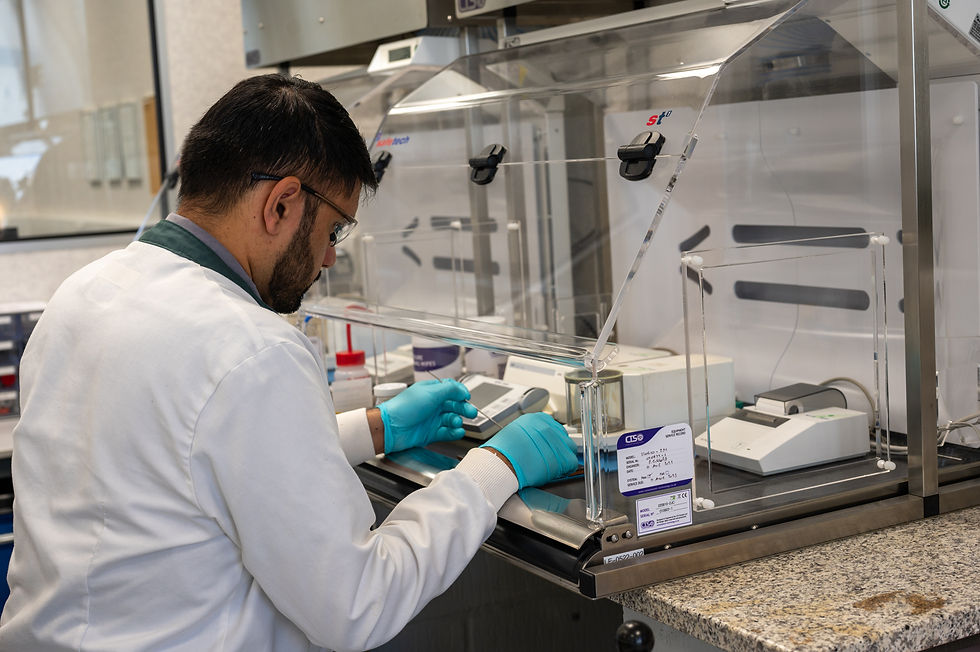
Battery materials analysis is only as good as the sample preparation behind it. Battery materials are often chemically complex and physically robust, and many of them do not break down using standard acid digestion. These materials present practical challenges in battery elemental testing, and it's essential to understand these before committing to a testing method.
Cathode materials such as those based on lithium metal oxides or silicates require hydrofluoric acid (HF) digestion to achieve complete dissolution. Without this step, any results from ICP-OES analysis could be misleading, with undissolved material not captured in the final measurement.
Glass-fibre separators and certain ceramic components present similar challenges. Not all analytical laboratories have the capability to handle HF digestion safely and consistently. It requires extensive investment in specialist equipment and a specialised team of chemists with experience in controlled HF digestion procedures. HF digestion capability is one of the first things to check when choosing a laboratory for battery materials analysis.
Getting sample preparation right is essential for accurate and reliable data.
What contaminants are most commonly screened in battery testing?
Trace contamination is a sensitive area of battery elemental testing. Since, small quantities of certain elements can have a significant impact on battery performance and compromise safety.
Common contaminants screened during battery materials analysis include:
Iron and copper — frequently linked to dendrite formation and internal short circuits, making them a priority in most screening programmes.
Chromium, zinc, magnesium, and calcium — these are less obvious, but each can disrupt electrochemical behaviour if present above threshold levels.
Lead, cadmium, mercury, and arsenic — heavy metals that are routinely screened, particularly where regulatory requirements apply.
These contaminants can be introduced at multiple touch points, through raw materials, manufacturing equipment, and processing environments A complete QC programme requires testing of incoming materials and in-process monitoring.
When should you use an external laboratory for battery testing?
For organisations without in-house elemental analysis capability, outsourcing can be best route for battery material analysis. This is particularly the case for:
Incoming material qualification, where testing is needed before materials are committed to production, but the volume doesn't justify in-house instrumentation.
Failure investigation, where an unexpected result or batch failure requires independent analysis to identify the root cause.
R&D and formulation work, where analytical requirements change frequently and a broad range of techniques may be needed across a relatively small number of samples.
Regulatory submissions, where data from an UKAS accredited laboratory provides a recognised level of assurance that results are traceable.
The value of external testing often comes down to the combination of experience, capability, and accreditation. UKAS accreditation to ISO/IEC 17025 means that results are produced under a framework of documented procedures, traceability, and independent oversight.
Battery elemental testing services in the UK
For battery manufacturers, material suppliers, and R&D teams looking to outsource elemental analysis, the key considerations are capability, turnaround, and accreditation. Not all laboratories can handle the full range of battery materials, particularly where HF digestion is required.
At Exeter Analytical, we provide ICP-OES and CHN analysis for battery materials across the full cell and component range. Our specialised team undertake carefully controlled HF digestion procedures to safely and effectively dissolve challenging matrices, followed by highly sensitive elemental analysis to precisely determine the composition of your battery materials.
View our elemental testing services for the energy and battery sector - https://www.exeteranalytical.co.uk/energy-battery-tech
Get a quote for battery materials testing
If you're working with battery materials and need reliable elemental data, it's worth talking through the sample type in advance.
Our team can advise on the most appropriate testing approach, expected turnaround, and reporting format before any work begins.
Request a quote today or call us on 024 7632 3223 to speak with our team.

Comments